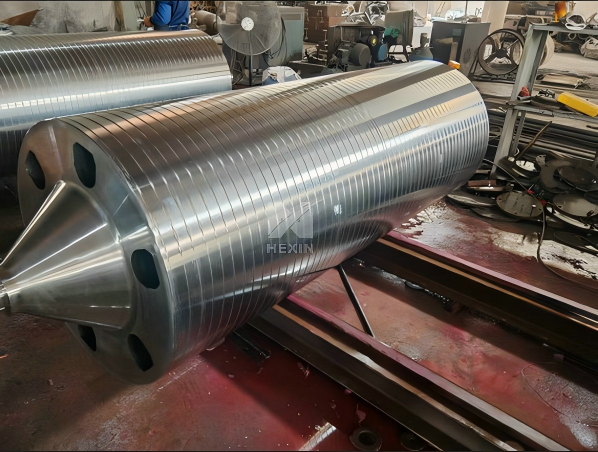
Key Advantages of Low-Ferrite CF-3M (316L) Sink Rolls in Galvanizing Lines
Sink rolls are continuously immersed in molten zinc or zinc-aluminum baths at approximately 460°C, enduring four harsh operating conditions: high-temperature zinc corrosion, cyclic thermal stress, friction from the steel strip, and long-term aging. High δ-ferrite content (FN 5–20) significantly accelerates roll failure; conversely, a low-ferrite (≤3%) single-phase austenitic microstructure effectively addresses these challenges. The six core advantages are outlined below:
I. Significantly Enhanced Resistance to Molten Zinc Corrosion and Extended Roll Sleeve Service Life (Most Critical Advantage)
1. Differences in Corrosion Mechanisms
Higher ferrite content results in more phase boundaries and denser corrosion pathways, doubling the rate of wall thickness loss.
2. Benefits of Low Ferrite (<3%)
The microstructure approaches a single-phase austenite state with minimal phase boundaries, eliminating pathways for galvanic corrosion. This significantly reduces the rate of zinc penetration and matrix dissolution, extending roll sleeve service life by 30%–80% under identical operating conditions and reducing the frequency of roll changes and downtime.
3. Enhanced Performance in Zn-Al-Mg Lines (High Aluminum Content): Al-Zn baths are more corrosive; high-ferrite rolls are prone to deep grooving corrosion, whereas low-ferrite rolls exhibit significantly lower corrosion rates.
II. Suppression of σ-Phase Embrittlement and Prevention of High-Temperature Aging Cracking
Sink rolls undergo long-term immersion at constant temperatures of 450–650°C. In standard CF-3M (5%–20% ferrite), δ-ferrite serves as the primary site for σ-phase precipitation:
With Ferrite Controlled Below 3%:
The quantity of δ-phase is minimal, preventing the formation of significant σ-phase precipitates. High toughness is maintained even after prolonged service, preventing brittle fracture or premature scrapping of the roll, making it ideal for long-term, continuous, full-load production. III. Uniform thermal stress; superior resistance to thermal fatigue and deformation
Discrepancies in thermal expansion and thermal conductivity between austenite and δ-ferrite:
During temperature fluctuations or production line start-up/shutdown, the difference in contraction/expansion between the two phases generates immense internal micro-stresses. Prolonged cycling leads to thermal fatigue micro-cracks that propagate along phase boundaries, eventually causing the roll surface to peel or spall.
Low-ferrite microstructure approaching single-phase austenite:
The microstructure exhibits uniform thermal properties and low residual internal stress, making it resistant to fatigue crack initiation during thermal cycling. The roll surface maintains dimensional stability, resisting ovality and surface irregularities.
IV. Resistance to zinc adhesion and dross buildup; more consistent strip surface quality
1. High-ferrite regions undergo preferential corrosion, forming loose ζ-phase zinc dross that adheres firmly to the roll surface, creating raised hard spots. High-speed friction against the strip causes the dross to scratch the surface, resulting in defects such as pitting, scratches, and uneven coating.
2. With <3% ferrite, corrosion products are continuous and dense, resulting in weak dross adhesion that allows for easy detachment via strip friction. This ensures long-term stability of roll surface finish, reduces surface quality defects, and lowers the scrap rate.
V. Non-magnetic; prevents zinc dross attraction and strip tracking interference
δ-ferrite is ferromagnetic:
Sinker rolls with high ferrite content exhibit overall magnetism; tiny iron-zinc dross particles in the molten zinc are magnetically attracted to and accumulate on the roll surface. Additionally, the magnetism slightly interferes with strip tension and tracking systems, making thin-gauge strips prone to tracking errors.
Ferrite <3%: The roll is virtually non-magnetic, preventing magnetic attraction of zinc dross and ensuring a clean roll surface, which enhances stability for thin-gauge materials and high-speed production lines. 6. More stable performance during post-production weld repair and refurbishment (balancing manufacturing and maintenance needs)
A distinction is made here between the cast body and the repair process:
1. For the cast body, ferrite content is controlled at approximately 3%; retaining a minimal amount of delta (δ) phase helps slightly inhibit hot cracking during weld repair, whereas if the ferrite content approaches zero, the material becomes prone to hot cracking after welding.
2. If the ferrite content exceeds 5%, the significant disparity between the two phases in the base metal makes the heat-affected zone (HAZ) susceptible to phase separation and localized accelerated corrosion, drastically reducing the service life of the roll sleeve after repair.
3. Low-ferrite rolls exhibit a uniform microstructure after welding; post-repair corrosion and crack resistance are comparable to those of new rolls, thereby lowering maintenance costs.