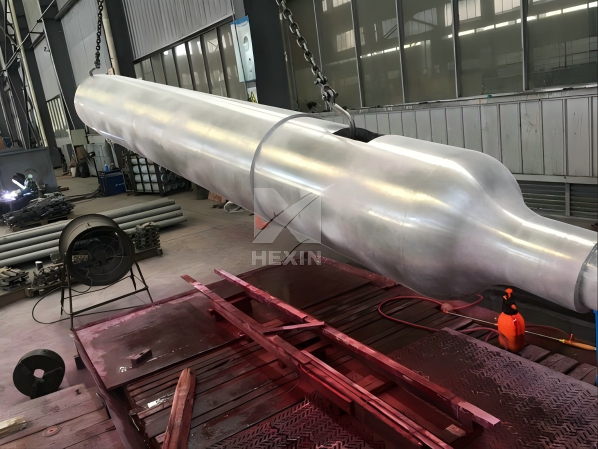
Cast Rotary Retort Main Application Scenarios
Due to its rotating structure and internal spiral shape, Cast Spiral Rotary Furnace Retorts are suitable for processing large batches of small, non-sensitive granular/bulk parts requiring continuous, uniform temperature, and controllable atmosphere heat treatment/sintering/pyrolysis processes. They are unsuitable for large parts, easily deformable materials, materials with high surface finish requirements, or highly viscous materials prone to coking.
Four Types of Workpieces to be Processed (Precise Industry Classification)
1. High-strength Fasteners, Self-Drilling Screws, High-strength Bolts (Most Mainstream)
Workpieces: 8.8/10.9/12.9 grade bolts, nuts, self-tapping screws, self-drilling screws, spring washers, miniature pins
Processes: Gas carburizing, carbonitriding, quenching + tempering, furnace temperature 860~930℃, RX endothermic atmosphere + methanol cracking gas (carburizing corrosion atmosphere)
Reasons: Workpieces with oxide scale particles cause wear and tear on the spiral; the carburizing atmosphere corrodes the weld seam, and welded guide ribs fall off in 3-6 months, while cast integral pieces can last 2-5 years.
2. Small bearing components, needle rollers, steel balls, rollers, miniature gears
Workpieces: Miniature needle rollers, bearing steel balls, small module powder metallurgy gears, oil pump pinions, valve spring seat rings
Process: GCr15/20CrMnTi carburizing and quenching, bright tempering, 830~890℃, nitrogen-based protective atmosphere
Operating conditions: Bearing steel has high hardness and extremely strong rolling friction; welded spiral steel plates are rapidly ground thin; cast high-chromium-nickel heat-resistant steel has outstanding wear resistance.
3. Powder Metallurgy Sintered Parts (Iron-based, Copper-based, Stainless Steel Powder Presses)
Workpieces: Powder metallurgy oil-impregnated bushings, gears, irregularly shaped small powder parts, stainless steel powder sintered blanks
Process: High-temperature sintering at 1050~1120℃, ammonia decomposition followed by hydrogen reduction, strong hydrogen corrosion + powder erosion
Key Issue: High-temperature hydrogen embrittlement easily tears carbon steel welds; therefore, integral casting of the spiral cylinder using ZG3Cr18Mn12Si2N or ZG35Cr24Ni7SiN is mandatory.
4. Special Metallurgy, New Energy Particle Raw Materials, and Hard Alloy Small Parts
1) Hard alloy granules, tungsten-cobalt granules, tungsten powder reduction (950~1150℃ hydrogen reduction)
2) Lithium battery precursors, lithium iron phosphate powder sintering (oxidizing/weakly corrosive atmosphere)
3) Stainless steel small stamping parts, small spring parts bright annealing (900℃+ high-purity nitrogen atmosphere)
Features: Dual damage from powder abrasion + high-temperature oxidation corrosion; welded cylinder life is less than 1/3 of that of casting.