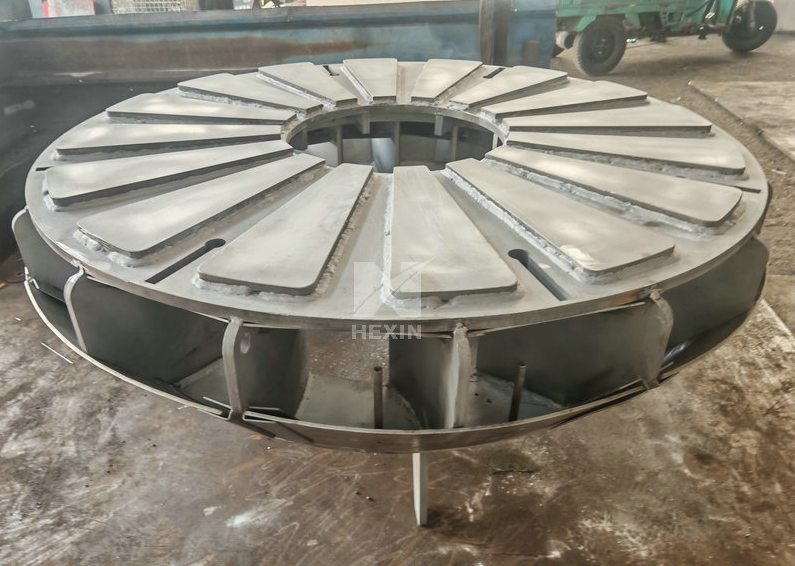
Material Selection for the Bottom Support of a Pit Furnace
The bottom support of a pit furnace is primarily made of high-chromium-nickel austenitic heat-resistant cast steel. The core requirements are high-temperature creep resistance, oxidation resistance, thermal shock resistance, and dimensional stability to support heavy-load workpieces and withstand long-term high temperatures and corrosive atmospheres within the furnace.
I. Commonly Used Materials and Selection
1. ZG35Cr24Ni7SiN(Re)
Applicable operating conditions: Most commonly used, long-term operating temperature 950~1050℃, short-term up to 1100℃. Suitable for general pit-type annealing, tempering, and carburizing furnaces.
Features: Contains rare earth (Re) elements, good resistance to thermal fatigue, carburizing, and thermal shock, suitable for operating conditions with frequent hot and cold cycles.
2. ZG40Cr25Ni20Si2 (2520 / 310S casting grade)
Applicable operating conditions: High temperature and heavy load, long-term stability 1050~1150℃. Used in high-temperature solution treatment, carburizing furnaces, and other demanding applications.
• Features: High creep resistance, oxidation resistance, stable structure, not easily deformed or collapsed at high temperatures.
3. 310S (0Cr25Ni20) Stainless Steel
• Applicable working conditions: Light-duty, non-heavy-duty supports.
• Features: Welded sheet metal, flexible forming, smooth surface, but high-temperature strength is lower than cast steel.
4. Ultra-high temperature materials (e.g., ZG40Cr28Ni48W5Si2)
• Applicable working conditions: 1200℃ ultra-high temperature, extremely heavy-duty areas.
• Features: Contains high alloying elements such as tungsten (W), extremely high high-temperature strength, expensive.
II. Core Performance Requirements
1. High-Temperature Mechanical Properties
• Creep Resistance: Core indicator. No significant plastic deformation or sagging under long-term load at 1000℃.
• High-Temperature Strength: Sufficient high-temperature tensile/yield strength to support the workpiece without fracture.
2. High Temperature Resistance and Oxidation Resistance
Operating Temperature: Matches furnace temperature, maintaining long-term stability at the design temperature (typically 1050~1100℃).
Oxidation Resistance: Forms a dense oxide film (e.g., Cr₂O₃) at high temperatures, preventing oxidation, peeling, and powdering.
3. Thermal Shock Resistance and Microstructure Stability
Thermal Fatigue Resistance: Does not crack or chip when the furnace body experiences frequent temperature increases and decreases.
Metallographic Stability: Austenitic matrix, no phase transformation at high temperatures, ensuring dimensional accuracy.
4. Corrosion Resistance
Resistant to carburizing, nitriding, sulfur/chlorine atmospheres, and dust corrosion within the furnace.
5. Structure and Process
Casting/Welding Quality: Dense microstructure, free of shrinkage cavities and cracks, high rigidity, and impact resistance.
Thermal Expansion Compatibility: Coefficient of thermal expansion matches the furnace body, with pre-reserved expansion joints.